Press - Shame - EN


Helpline 03 018 019
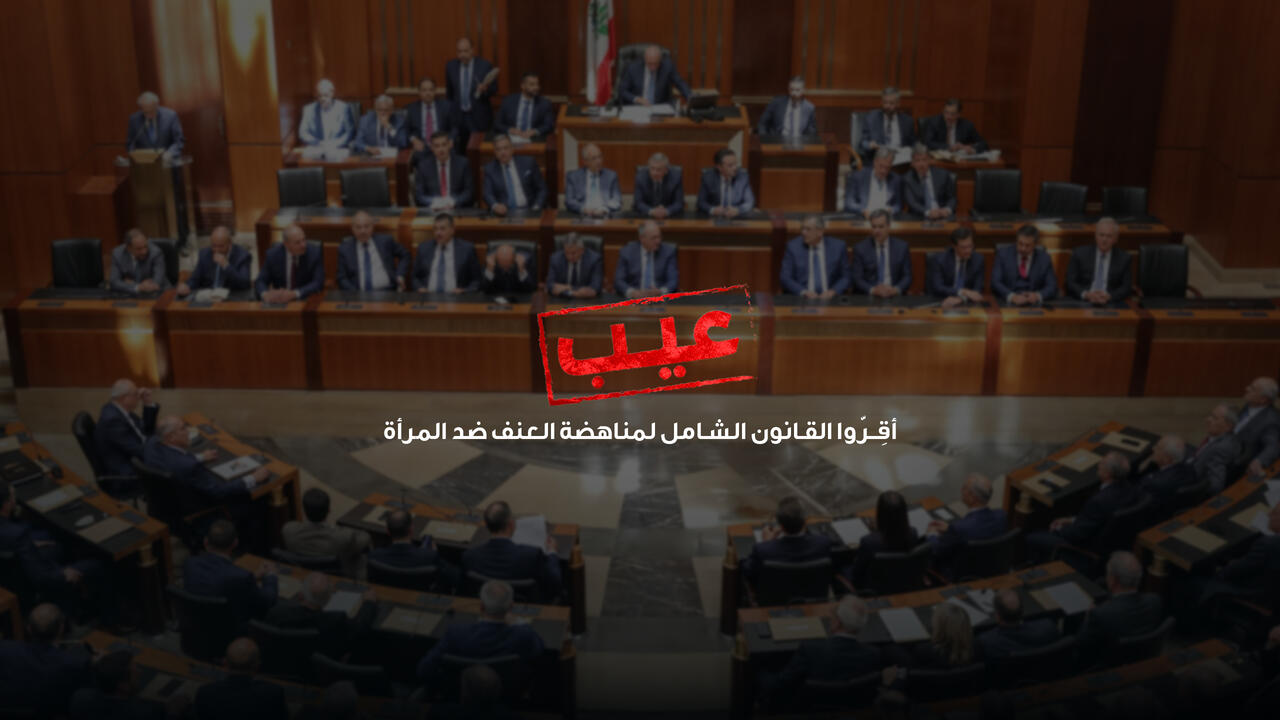
It is time to pass a comprehensive law to combat violence against women
Every year, the global 16 Days campaign to combat violence against women is renewed. But in Lebanon, it is accompanied by renewed official denial of the existence of this violence in the first place.
Until today, the Lebanese state has not clearly and explicitly acknowledged that violence against women is a national issue that requires a serious and comprehensive institutional response.
This systematic denial—reflected in the absence of preventive and protective policies is nothing but an expression of a deep disconnect between state institutions and the reality women live every day.
Women and girls continue to face multiple forms of physical, sexual, psychological, and economic violence, in the absence of comprehensive legislation to combat this violence.
Real indicators confirm that violence against women and girls is a systematic social phenomenon that requires a radical political and legislative confrontation, not justification or neglect.
A quick review of Parliament’s performance on women’s issues shows that women were the ones who demanded protection from domestic violence, yet Parliament responded by protecting all family members from violence without dedicating protection mechanisms specifically for women attempting to show that violence committed against women is no different from any violence committed against other family members, ignoring the unequal power relations within the family.
Women also demanded the criminalization of sexual harassment, yet the law criminalized it in a general way, without acknowledging that women are the primary victims of these crimes, under the pretext of formal equality an equality that is practically eliminated when it comes to equality of rights within personal status laws.
Returning to reality, the numbers indicate that 89% of complaints to the Internal Security Forces’ 1745 hotline (dedicated to domestic violence) are made by women, and that in 57.5% of cases, the husband is the perpetrator followed by a notable percentage of male family members: fathers, brothers, sons, and ex-husbands.
These numbers do not reflect “family problems,” but a power structure that entrenches male domination and justifies violence against women.
From here, the demand to pass a comprehensive law to combat violence against women is not a luxury nor a privilege, but an urgent national necessity.
A law that provides integrated protection for women in both the private and public spheres, based on essential pillars:
Prevention of violence through awareness, education, media, and the elimination of discriminatory laws.
Protection through effective and rapid response and support mechanisms.
Prosecution and punishment of perpetrators through a specialized and fair judicial process.
Compensation and empowerment of victims, ensuring their social and economic reintegration.
Violence against women is not a “private” issue, but a political and national one that reflects the state’s view of its women—as citizens entitled to safety, dignity, and genuine equality.
The silence of the authorities is negligence, and negligence is complicity in the violence committed.
On the occasion of the 16 Days campaign to combat violence against women, we affirm that violence is not fate, but a direct result of the absence of political will.
It is time to correct this path.
#Shame
Pass the comprehensive law to combat violence against women in peace and war